Tuesday, November 07, 2006

End of Aldeburgh

Where did it all go? One minute the weekend dizzies delightfully before us, the next it's over. Sunday was a modest blur, beginning with the hugely popular reading by the Joy of Six, whose venue - like that of many other events - was full with a queue of hopefuls. TJOS is in fact five people, all well established poets in their own rights. André Mangeot, Andrea Porter, Anne Berkeley, Peter Howard and Martin Fugura write and perform together, reading a combination of individual and group work. The hands down favourite piece for Sunday's hall of poets was Poets' Retreat, from Martin Figura's 2005 collection ahem, and read by the group. If there was a sub-species of poet from whom this hilariously sinister poem did not take the mickey I don't know which it would be:
...
The concrete poets, for obvious reasons, were less quick
and paid the price. But they have found a certain peace
and are with their own kind holding up the flyover
at the Junction with the A66.
...
Following a less than swift cup of tea in the White Lion, we set off for the finale reading: the ever wonderful Vicki Feaver, an incredibly good German poet, Durs Grunbein, reading with his unfortunately almost inaudible translator Michael Hofmann, and - once more to the microphone - Sharon Olds reading work selected by and on behalf of her friend Philip Levine.

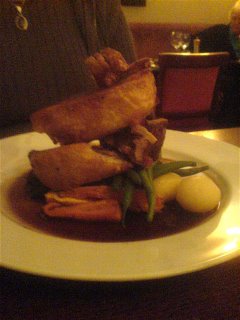
Supper was a delicious trip to the Crown and Anchor in Orford, proving ground for Ruth Watson's imaginative food in a cosy and friendly hotel which has in the past delighted the likes of Nigel Slater. We sipped some sublime old sherry while considering the menu, deciding upon guinea fowl on a pea and chervil risotto; a towering portion of crisp, juicy pork belly on a well seasoned kindling of vegetables;

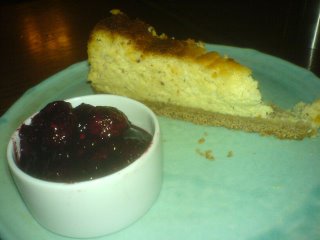
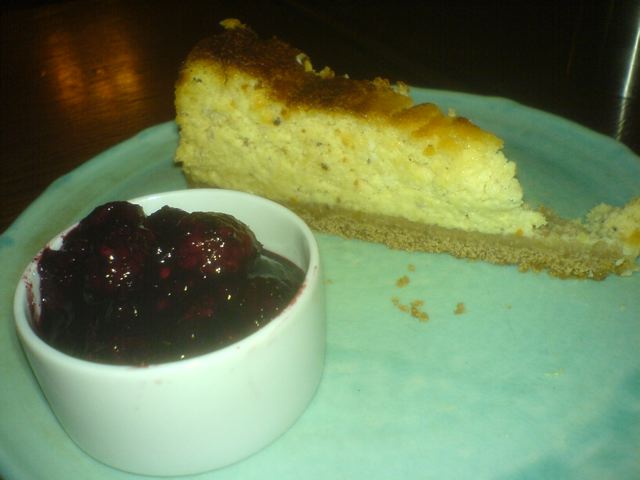
and a perfectly pan-fried fillet of hake on saffron mash with fresh spinach. The desserts were not so successful, the pumpkin cheesecake a bit watery - maybe not sieved? - but for whatever reason a bit too vegetable-textured for my taste.

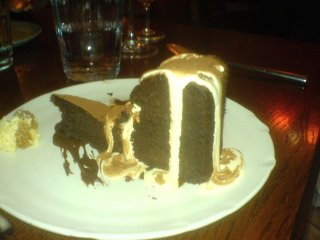
The cheesecake looking a bit lonely with its luscious loganberry companion at its side, after half of it had been spirited away to another plate... and I found the bitter chocolate souffle cake pretty much inedible - hard and uninteresting even with a darling little pot of cream to pour over it. I'd been reading up on the pudding recipes beforehand (the chocolate one came from Something for the Weekend) but not carefully enough, as I thought there would be some give to the texture. Oh well. Everything else was so good it was overkill anyway. And it did look quite majestic.

Labels: ,

Saturday, November 04, 2006

More Aldeburgh Poetry

Saturday was a long 'un. After our workshop (and fish pie) we dashed off to Aldeburgh to attend the conversation with Sharon Olds. Michael Laskey presided, in place of Philip Levine who'd had to cancel, and did an admirable job of getting some background from a poet who's been reviled and revered in equal measure, it seems.

Laskey asked her about some of the "strongly felt and strongly put" criticism that must have made her career deeply uncomfortable at times, from, as she said, "critics who were at pains to tell me why what I did was not poetry." Although she'd been writing for many years, she'd taken a long time to publish her poems, which she'd really never thought anyone but she would see (her first collection came out when she was 37). She'd tried to learn to cope with the hardest criticism: over time she was able to drop one phase of her response to it - the four parts of which were to burst into tears, throw up, fly into a rage, and finally fall asleep. At one point she actually made a chart listing her poems, with the negative adjectives attributed to each, and tried to learn from this what emotions certain themes were raising in her critics. It's hard to imagine anyone surviving the kind of battering she's had on the public stage; how much does prescriptive criticism really help? Give me instead the school of thought that says if you don't like it, don't read it -- and move on.

In terms of process, she said she'd historically always written very quickly and often in single drafts with little or no changes, a process of gathering, and at a certain point "the gates open and the poem comes out." She says she revises more nowadays, and her editing rule is to write the draft and then "remove half the adjectives and a third of the self pity, so the poem doesn't have to carry so many rocks in its pockets." She remarked on the danger of place-holders: words she'd stuck in her lines while she tried to think of something better, which to her surprise began to resonate with the music and sense of the poem so that it would become difficult to get rid of them later. She spoke of the importance of the "objective correlative" - an object that correlates to some emotion in the poem - without which the poem might blather on, self-absorbed, talking about itself too much instead, let's say, of the tiny pair of scissors.

Her aims in the bigger world of poetry are to increase poetry's reach and to help it to join with the wider communities in which we live. She said she'd been inspired by Jean Kennedy Smith's founding of Very Special Arts in the 1970s, and that her dream - attempted when she was Poet Laureate of New York State - had been to try to encourage every writing MFA program to reach out to jails, mental institutions, hospitals, special schools, hospices and introduce writing programs in these. She feels it is a profound way to extend the usefulness and place of poetry into a larger world, and create a community for poetry - as well as a means of providing teaching experience to writing program graduates.

Next on the bill was the Master Class Poetry Workshop, led by Vicki Feaver with Michael Laskey co-hosting. Following a time-tested format, the Aldeburgh master classes present poems selected from the work of experienced but not necessarily widely published poets which are discussed first by the workshop leader, then the other participants, and finally by members of the audience, before the poet may - if wished - say a few words in response. The participating poets were Julia Bird, Administrator of the Poetry School, up and comer Valeria Melchioretto, and Sam Riviere - whose nicely turned poem "The Kiss" seemed the most technically interesting, being written in paired statements, employing some of the constraints of the palindrome:
the more she thought
she'd keep it to herself - he'd never know
exactly how it happened (she didn't know)
and he'd see replays of her face
opening and reaching towards his face
.. and so on. Useful quote du jour from Vicki Feaver: "One test of a good poem is to ask if it's about more than one thing."

Finally we moved into our third and final event of the day, once again balancing on the brink of perishing hunger and fatigue, and by now more than well burdened by books. We were all delighted by the Scottish poet Alastair Reid, unknown to all of our group but historically much published and apparently all out of print - a situation the festival organisers had deftly dealt with by publishing a fine little chapbook that many of us snapped up. He was a delightful reader and a name to look out for. He was followed by a distinguished Spaniard, Joan Margarit, whose passionate recitations in Catalan were interlaced with softer renderings of the English translations by Anna Crowe; best bits were his daring to read two translations himself, expressive and entirely well spoken. Final reader up was Sharon Olds, who read mostly new work, including poems of humour and wry digs at her critics, in her usual gracious manner and clear, simple style.

Enough food for the mind: off we went to our long awaited meal at 152, where 10 of us shared a groaning board. Pot-roasted pheasant for me, with braised red cabbage (with fennel? anise? some unusual and not unsuccessful seasoning) and a glass or two of tempranillo, followed by my dish of the day: coffee creme brulee. A perfect ending.

Labels: ,

Aldeburgh Poetry

Another day, another meal. We had a gorgeous fish pie for lunch today, mid-poetry workshop. Tammy attributes the recipe to Clodagh who pinched it from Sophie Grigson. The world's simplest fish pie, but success entirely depends on using absolutely fresh fish. (A doctor/scientist I met on the bus in London a couple of days ago adds that it must be a Sea Fish, for the iodine, which you need for a healthy thyroid.) Take your fresh fish and lay it in a buttered baking dish; mix up dry bread crumbs, lots of fresh parsley, some chopped garlic, salt and pepper and sprinkle it over the fish. Drizzle with melted butter. Squeeze lemon juice over all and bake at 220c for about 20 minutes until the fish is just done and topping is golden.

A slice of fondly remembered Suffolk Gold Cheese.

We had an entirely local meal in fact. Fish from the last hut on the left, on the seaside in Aldeburgh; local greens (rocket, Belgian endive, radicchio); local new potatoes. We finished with the cheese which was heavenly, particularly the St. Andre/vignotte, which is a lot like eating butter (it's triple cream, but who's counting).

Last night's start to the poetry festival included a free session, an excellent idea that didn't quite work. Various festival guests are invited to present 15 minute "Close readings" of poems. Last night's was Sharon Olds, presenting "Those Winter Sundays" by Robert Hayden. The reading wasn't quite close enough for my taste, although I like the poem, but I think it's a hard one not to like. We then went on to Jubilee Hall to hear three readers: Nick Laird, who'd won last year's Jerwood Aldeburgh Prize (part of which is a featured reading at the following year's Aldeburgh); John Powell Ward and Jenny Joseph, who was not wearing or reading anything purple. She did read a six minute poem towards the end of her set, which we debated later: is it better not to warn the audience that you're going to do this? I didn't mind the warning (sorry) but did mind that she chose this one to read next to last, when we were perishing from frozen bums and looking forward to a late supper. We didn't get out till just before 10pm.


We had been forewarned that last orders at our restaurant were at 10pm, so we had to sprint down dark streets to secure our plates at The Lighthouse. Ah, succulent Irish oysters with shallot vinegar; an excellent taramasalata; some gorgeous looking calves' liver with bacon; a crisp dirigible of halibut on home-cut chips; hot scallop salad; roasted cod - it all paraded by, and some of it even stopped at our table. The rioja was perfect. A nibble of Mike's walnut tart with butterscotch ice cream was enough to prove the excellence of the sweets. We'd earlier witnessed - but passed on - some brutally beautiful desserts in Orford: hot lemon cake with spooning cream; pineapple ice cream served frozen in a wedge of pineapple.

Labels: , ,

Tuesday, June 13, 2006

Ottawent

So, party's over, and I'm back at the trail's end/beginning.

League of Poets AGM ended after two more days of meetings and readings and meetings and readings. By the end of Saturday's banquet I could not have eaten another bite or heard another word.

We had a keynote address on Saturday night by longtime member (indeed present at the founding meeting of the League) Margaret Atwood. She was in droll mood and after a charming and carefully bilingual introduction by Pauline Michel, she launched into a quip-packed 40th anniversary address, on the subject of Why Poetry? (Her lecture will, they tell us, be printed in full in a future issue of Prairie Fire.)

She said she'd joined the League back "when poetry was top dog," when, like her, many of today's Canadian novelists were beginning their careers -- as poets. Recounting a couple of sweetly sordid anecdotes, she remarked that back then the poets - mostly male - were living in the afterglow of Dylan Thomas and John Berryman, and self-destructive acts were part of the job description. She felt that these days she'd send aspiring poets to plumbing school: there's always a demand for your services; it's easier to think about poetry when doing something with your hands; and it's nice and dark under the sink.

So then she got to her question. Though we no longer think we can conjure rain, or even mildew, or have our heads chopped off for writing poetry, we are in a tamer age than when words were more potent. Why then do we do this poetry thing, whether written or oral, or is it built in?

Instead of providing answers, she offered what she called some potentially interesting sidelights.
1. Reading, writing and speaking are all located in different parts of the brain.
2. If the speaking part of your brain is knocked out, the singing part may still remain.
3. Words have their own address book in our brain: we recognise that John Smith is a different thing from a carrot. Poetry can serve as an aide-memoire (to prove her point, she had us filling in the blanks of Alligator pie; Alligator pie... )
4. Music, poetry and mathematics are more closely related than poetry and prose. There's a system of pattern recognition at work that's connected to music and math - and of course she was speaking here of rhymed and metered verse rather than "that which resembles prose".
5. Fire and grammar are what distinguish humans from other life forms. Only humans cook their food, and having reduced the time we would have spent digesting unprocessed food, we have thus liberated up to five hours per day for other pursuits. And though animals may communicate through noise, they lack grammar. The dog can and does think in past and future tense, but no dog is likely to question where the first dog came from, and where do dogs go when they die.

Oral cultures, she went on, swam in a sea of language; but now we live on comparatively dry shores, extruding our brains into other technologies, and so that part of our brain has probably shrunk. Technology and numbers are said to represent 'the real world' - as opposed to the obsolete world that poets occupy. But we make what we long for, and destroy what we fear, as we have always done; these things have not changed, and we know this because we have poetry. Human imagination drives the world: it directs what we do without our tools, and poetry is part of the way we sing our being.

There followed the banquet (some very good grilled chicken or cedar-planked salmon) and awards ceremony. I was thrilled that Suzanne Buffam won the Gerald Lampert Award for her wonderful book Past Imperfect. She read the lovely poem Please Take Back the Sparrows.

The winner of the Pat Lowther Award was Sylvia Legris, for Nerve Squall, reviewed with considerable venom in the Globe and Mail earlier that day. A tragic waste of newspaper space for the single review of poetry on offer, and a badly ill-judged match of reviewer to subject, as the reviewer himself admits: "Those who enjoy linguistic foreplay, and the pinball wizardry of caroming words, will favour this book. Those like me will find that it all adds up to narcissistic inconsequence." Well, it's not my cup of tea either, but if it was good enough to engage the not inconsiderable intellects of the juries of both the Griffin and the Lowther awards, and prove itself the stand-out over hundreds of other collections, it can't be as bad as all that. It would have been far more useful to hear from a critic able to explain just what that power was, in the context of all its competitors. Surely the Globe could have scraped the barrel a bit harder and found a reviewer who could deal with the book in its own terms?

A more interesting article in the Globe and Mail about the origins of ABE, the online treasure trove for book lovers.

Labels:

Friday, June 09, 2006

League Day One

Day one of the League of Canadian Poets AGM (and 40th anniversary celebration) was meet 'n greet -- lots of people I haven't seen since my first League AGM in 1993, and some I have met along the way. We had an open mic (asking for trouble, I read the Rhonda Poem, but it didn't - as I feared - initiate a rash of "d" word mishaps) which rattled along despite the looong list of participants. It was a great way to introduce ourselves to our fellow bards. After lunch there were a couple of afternoon workshops.

I went to the poet laureate panel, which featured Pauline Michel (Poet Laureate of Canada), Louise Halfe/Sky Dancer (PL of Saskatchewan), Lorri Neilsen Glenn (PL of Halifax) and Alice Major (PL of Edmonton) plus Cyril Dabydeen who had been the second (and second last) PL of Ottawa. They spoke about their various duties and the many surprises that awaited them when they took up their laureates.

Michel spoke at length, in beautifully written English, and occasionally burst into song, about what and why she does what she does. For her the job of the poet ("we are all poet laureates") is to promote writing as a means of artistic expression: "what is not expressed either implodes or explodes" she said; "but where do the arts firt into a culture where a good living is more imnportant than a good life?" She had managed to get funding for an assistant to schedule her events, a role that was fulfilled during the term of the first PL - George Bowering - by his wife; the requests come thick and fast and Michel said she thought three years should be the minimum length of the term to allow enough time to see through her various projects and duties.

Louise Halfe spoke first in Cree, and sang in her language as well. She assumed the Saskatchewan mantle from the province's first PL, Glen Sorestad, and has relished her ability to reach audiences and communities that she is uniquely able to connect with. A former social worker and addictions counsellor, she says she no longer practices but has incorporated her work into her art. She remarked that once again she was the "lone Indian in the room" and that she is expected to represent all the Indians of Canada, regardless of the fact there are many nations.

Lorri Neilsen Glenn, the second PL in Hlaifax, is a year into her four year term. She has a Cree grandmother and Quebecois grandfather and has lived in Halifax for 22 years, "which of course makes me a newcomer" she said. Her appointment coincided with a cut to the municipal arts board, which was shortly followed by the resignation of the cultural officer, so she has struggled without a helping hand to coordinate her duties and help her obtain funding for events. Like the others on the panel she observed the role could easily be full time if she allowed it - though the $1200 stipend would make that tricky. She hopes to help prove that "there is more to Nova Scotia than lobster traps and people who say 'buddy' and 'arse'."

Alice Major, the first PL in Edmonton, spoke about the politics of her role. She said on her first (of potentially three) command commissions she was asked to write something for a gathering which included the premier. "What," she asked, "can one say to Ralph Klein?" But because she was there by invitation by the supportive city council who had worked so hard to create the role she was occupying, she put her politics in her pocket and wrote something suitable to the occasion. "Nice," said Ralph as she walked back to her seat. Her second commission she titled "The hockey poem I thought I'd never write" - a work dressed to impress her audience, it was printed in the Edmonton Journal the following day and then hit the national papers the day after. "All these volumes of verse I have written, which no more than 500 people will ever see" she mused, "and the poem that makes the national papers is the hockey poem."

The second and last workshop I went to was about poetry in health and mental health institutions. Shirley Serviss kicked things off by describing her work at the University of Alberta Hospital in Edmonton. Working 15 hours a week at this, she is part of a group of professional artists - poets, visual artists and musicians - who are based there, together with volunteers (including poet Ted Blodgett who comes by to play the lute for patients). She described some of her efforts which take the form of anything from transcribing poems to the white boards that seemingly cover every wall, to dispensing poems to doctors, nurses and patients, to bedside work encouraging patients to talk about their lives so she can write them poems, or helping them to shape the words themselves. When she undertook an MA in Theological Studies she had thought she wanted to do a hospital chaplaincy but she prefers this work, which she has had incredibly positive feedback on from family and patients alike. She thinks it fills a gap in patient care as well. "They can turn chaplains or counsellors away," she said, "but we disarm them: all I'm doing, after all, is giving them a thought for the day."

Ronna Bloom is a psychotherapist who has given many workshops to health practitioners. She described one of her popular ones on overcoming personal blocks, which works well on people even if they are not writers. She is careful to explain to participants that the exercise will not solve anything, but it might give them extra information about what is blocking them in their lives or work. She pointed out that blocks are there for a reason, and it's important to remember we might love the places we're stuck, so her workshops are not about simply kicking them away. She says she knows the things that won't work, and these include guilt, denial, willpower, or moving house or countries. Her workshop aims to help participants get a good clear look at their block by making it larger. She alluded to a principle of martial arts which suggests that you cannot overcome an opponent by fighting them; but if you join the opponent, you can use that energy to defeat them. And so her workshop starts by allowing participants to describe what they love and hate about the block. They write about what they really want. Ronna then reads them a poem of hers which is a blessing, and asked to write one that blesses some aspect of themselves.

Ron Charach is a psychiatrist who also writes poetry. His poetry column in the Medical Post elicited enough poetry to engender an anthology by Canadian medical practitioners, and he's had poems in such oblique markets as The Lancet. He discussed research that had been done into connections between poets and mental illness, and ended by giving us a handy prescription to assure mental soundness to allow us to carry on writing.
  • Get enough sleep and natural light;
  • avoid substance/alcohol abuse;
  • keep some structure in your life;
  • pace those overwhelming projects;
  • maintain your relationships;
  • take all threats of suicide seriously;
  • don't hesitate to get professional help.

Labels:

Monday, March 27, 2006

Words on the Water and after

So: the Words on the Water writers festival (check out the virtual tour of Campbell River!) was a good old time. We arrived, on a day of brilliant sunshine, at 8:30 sharp and purchased $40 worth of tickets for all the day's readings, of which there were eight, in four sessions. We heard that the Friday night gala had been a success, and were offered a few newly added (thank you fire department) seats for the Saturday night literary cabaret. But in the end we decided against staying for the evening as well, since all the readers were the same as for the daytime sessions, and we felt in our bones - and a few other places - that sitting through the first 8 hours of readings was probably enough.

Evelyn Lau kicked things off with some poems from her new collection, Treble. She talked about the autobiography of writing: even when she's writing fiction, she said, she's in the story. She came across well and was warmly received by the audience; though she had some serious zing in some of her poem endings I opted to spend my cash instead on another gorgeous Gaspereau poetry collection by Jan Zwicky, Thirty-seven Small Songs & Thirteen Silences. As she'd been asked, she talked a bit about philosophy, music and poetry and how these come together for her; and she quoted Don Paterson, in an introduction to his translations of Spanish poet Antonio Machado, who'd observed that Spanish is a guitar, while English is a piano.

We had a break then, with treats supplied by Save-on-Foods, the official festival sponsor. Although I'd raised an eyebrow when I saw the supermarket was also selling the books, after a day feeding on their goodies (including a very nice lunch buffet) I came round. But it would have been nice to see a local independent bookseller, if there is such a thing in Campbell River, reap a little of the benefit of the event, which saw about 150 people attend the day's readings.

We heard some prose then, from Claudia Casper, and some poems - read in his characteristic moaning growl- by poet, typographer and bringer of tales from the Haida, Robert Bringhurst. One of his suggestions was that all Canadian children should be required to learn at least one indigenous language so that they may read, in their original words, stories in which humans are not the most important elements.

And stood in a long long queue for lunch, after which we had more prose, from Annabel Lyon who talked about music, prose and law school, and read a bleak little tale she'd gleaned from a murder trial she'd once watched; and some new and hilarious writing from our favourite storyteller David Carpenter.

Another break and we sped toward the finish with poetry: first, Gregory Scofield demonstrated that had he chosen another path he could easily charm the words from the trees as a singer. Then Patrick Lane wrapped things up with a reading from his memoir and a few newer poems. He remarked on once being stunned to discover that a metaphor he was teaching about a wren was lost on a group of first year university students, only a couple of whom were aware that a wren was a bird.

We enjoyed a sunny afternoon drive back to Courtenay, where we stopped in to enjoy a bit of gin and some patatas bravas and some spicy squid in garlic yogurt at the Union Street Grill and Grotto before pressing on to Fanny Bay to put our feet up and rest our weary heads. In the morning we scooted back down the island, pausing to make a side trip to Thetis Island for lunch, and then on to Victoria in the sprinkling rain.

Labels:

Tuesday, March 21, 2006

Words and water

Just looking ahead to a weekend's literary merrymaking in Campbell River. The Words on the Water writers festival, being held in the Maritime Heritage Centre, starts on Friday. Even with a disabled website (some tragically ill-timed mishap involving corporate changes in their service provider ownership, coupled with who knows what associated administrative problems) they've managed to sell out their weekend passes and their Friday and Saturday night events.

We're hoping to get to the Saturday daytime sessions at least, which will feature Evelyn Lau, Jan Zwicky, Claudia Casper, Robert Bringhurst, David Carpenter, Annabel Lyon, Gregory Scofield and Patrick Lane.

Because we can't get into evening readings, I reckon we'll be forced out onto the cold wet streets in search of alimentary culture instead. One pilgrimage I am never too sorry to make when I'm in Courtenay is to Tita's, which I bet is the best Mexican food on Vancouver Island, or I'll eat my sombrero.

Labels:

Sunday, March 12, 2006

The end of my Austin

Well it was a delicious last day in Austin. We braved temps in the high twenties (while it was snowing in Victoria??) to get to the conference centre for the last day of AWP panels. I slipped into the book fair for a final decisive purchase: Robin Skelton's The Shapes of Our Singing which I hadn't realised was even in print. Very succinct and comprehensive - not to mention conveniently alphabetical - listing of forms both common and obscure.

As if I'd invoked him, Skelton's name was mentioned early in the first panel I went to: The Poetic Sequence, when Madeline de Frees confessed to having taught at one time at UVic when he was still at the helm, and said he'd told her poetic sequences mean never running out of things to write about. We heard also from Chase Twichell, attending AWP as both publisher and writer, reading - too briefly for me - from Dog Language which I'd picked up earlier at the Copper Canyon stand(--hey, she owns an Australian Shepherd/Border Collie mix: she must have *some* excess energy!) ; Matthew Zapruder; Gregory Orr; and Erin Belieu, who gave us a hilarious introduction to her ferociously angry sequence, In the Red Dress I Wear to your Funeral.

The arguments given for the poetic sequence seemed at times to be similar to those for writing novels: lots more room to explore your topic, scope for making giant leaps and conjoining disparate ideas. And an opportunity to scope out some formal challenges: Orr, on the subject of his Orpheus & Eurydice, talked about using myth as a known narrative against which he could pose lyric moments to illustrate points of crisis in the story - a kind of "between the lines" approach to the subject that touched some sympathetic nerve in me and made me think this might be a good touchstone. Zapruder used a repeating name in a descending position in each of twenty 20-line poems as a response to grief. De Frees quoted Arthur Koestler who suggested the laws of association are multiple and varied: if two things occur to you at more or less the same time, they are connected, and you as the poet become the connection's vehicle.

Moving right along I went to Blogs, Boards and Online Journals: Salons for the 21st Century. We had some big names in blogging: Ron Hogan (Beatrice.com, one of the oldest poetry blogs around), Rodney Shankar (Drunken Boat), Tony Tost (Unquiet Grave), Joshua Corey (Cahiers de Corey), and Poets.org editor Robin Beth Schaer moderating. Lots of ground covered: blogging every day will improve all areas of your writing; aspects of engaging in the dialogue with other bloggers - pro and con; differences between the way online journals, listservs and blogs shape a dialogue (differing in the amount, type and direction of the communication); corporate uptake of blogs ("now HarperCollins has started a poetry blog, is the end in sight?"); the way that online journals have separated poetry publishing from "prestige journals" and offered a forum for publishing writers from around the world who might never have found their way into US print journals. And more and more.

For my interests it was rather too male dominated, which I hadn't realised was bothering me until the chasm was opened by a late question/comment from a woman blogger who said (contrary to earlier discussion about blogs being a primarily male domain and not much participated in by women) that she knew a lot of women bloggers, and that they were writing to keep in touch with one another's lives rather than to air opinions or theories. That she knows women who've unsubscribed to listservs that get taken over by male argument. That the blogs of women she knows are not single-focused (e.g. purely on writing), but sprawl across the whole of their lives, so might include writing, parenting, work and (yes!) dinner. And that because they are just "my blog" and not "THE (or A) blog, on xyz" they may simply be passing beneath the radar of male bloggers who focus on and read the more specific blogs (as her husband does) and go unremarked in more academic links. It seemed an extension of male/female attitudes to compartmentalisation, agreed one of the panellists. The topic of women's literary (and whatever) blogs seems to be a panel topic in search of a conference.. Meanwhile, there is WOMPO, a listserv devoted to the discussion of women's poetry.

On I went to Low-Residency MFA Programs and the Pedagogy of Online Classes, which was a panel from the University of New Orleans. Because they were up on their distance ed methods, and the residency parts of their programs are taught in Spain, Italy and so forth, they suffered less than many of the other faculties when Katrina hit. Yeah, tempting program (though apparently they lose a few students during the running of the bulls at the Fiesta of San Fermin each year)!

In the online courses, they do online workshopping and the instructors present had conflicting policies on whether to allow or require students to edit their posts, and whether to delete posts or not for example in the case of personal attacks. They found students were typically very careful and sensitive in their comments on their classmates' work, though discussions sometimes got heated.

One of the former students said low-residency programs were a very different experience depending on whether you started with the residency or plunged straight into online, but felt they were a good model for a writing life, because staying on track with the workload imposed a solitary discipline that was helpful down the line. She thought there was less of the sense of loss that residency MFA program grads might experience after a year or two of close contact, as low-res students were already used to staying in touch over distance. Another former student offered some suggestions for building community in online classrooms: add a forum for the kind of idle chitchat that takes place in face to face classes; post pictures of students to personalise the dialogue; include an opportunity for students to introduce themselves; ensure students have some basic html to make posting easier (how to add italics, links etc.); encourage face to face meetings at conferences etc.

One discussion came up about the expectations, on the part of students, that instructors would respond instantly to questions and were sometimes kept waiting too long (e.g. for technical questions); vs. instructors who had let the online workshop take over their lives. One instructor commented that a couple of hours in a face to face workshop seemed a positive luxury over the 20-30 hours per week they were spending teaching online ones. But on the other hand, online gave them the luxury of considering and revising their responses to creative work and to posts.

And then for something completely different I tried Ballads vs Ballads: Poetry and Songwriting. For me the two most interesting discussions were those of Charlotte Pence, who teaches in Nashville, and songwriter Tim Jenkins. Pence said that a quarter of her students were music majors so songwriting was central to them, and she studies song lyrics with them as a bridge to a study of literary lyrics. She discussed a theory that compares the structure and rhetorical techniques of country and western song lyrics to Shakespearean sonnets and referred us to an article by Jill Tedford Jones for more on that topic.

Jenkins told us about the process used in songwriting workshops, which sounded not unlike poetry workshopping - same but different. They start by determining the structure (rhyme scheme, chorus use/not etc.) and whether the song follows and acknowledges the expectations and history of its structure. They go through the musical/lyrical stress lines, matching the stresses in the music to those in the words (are they natural, appropriate). They look at the "genre goals" - does the song follow the rules of its form (for example, in country and western, you need to introduce all the characters in the first couple of lines). Then the rhetorical situation: who's going to be singing this, you or someone else, because that affects a number of things about it. They look at the use of words as instruments for singers: vowel sounds for emotional impact (e.g. a long "e" held over time tends to make a singer sound strangled). He demonstrated live with his guitar which was a nice change from straight panel discussions. They recommended Pat Pattison's books, and commented briefly about transporting poems into songs (Jenkins says he loves doing this, but will almost always have to "tweak" a bit - maneuvering rhymes and sometimes restructuring lyrics to make them work with the melody). A comment came up about cliche as a communal sense of emotion in song lyrics: part of an emotional register that works in song rather than poetry, and part of why country and western songs include, or perhaps require, puns and cliche.

The final session was Prosody for the 21st Century. The panel was Annie Finch, Timothy Steele, Marilyn Taylor and Thomas Cable. Impossible now to summarise but the message - both from the panellists and from the size of the audience (I counted about 100) seemed to be that there's a lot of metrics about, whether deliberate or instinctive, and that we need more than iambic pentameter to fill the gap. There was talk of Derek Attridge's Rhythms of English Poetry, and his alternative scansion of beats and off-beats rather than conventional foot scansion, which seems to work better with freer verse forms. The point was made that you can of course scan anything, but what makes something metrical is repetition with pattern.

After a last sweep of the book fair, we headed to Tesoros for some focused browsing of a whole lot of everything and slipped out when the store closed. For food du jour we went back to Cuba Libre for Sopa de Poblano - fabulous, with a side of fresh chopped tomato, cilantro, tiny cheese cubes, fried tortilla strips to add - followed by coconut shrimp with a jicama sweet pepper salad (I wouldn't call it slaw as the menu did). Judy had black bean soup with plantain chips and a pair of dense, rich crabcakes. We sprinted back to the Hilton on mojito moccasins and caught the end of Timothy O'Brien's lecture and finally what was left of the Academy American Poets Poetry Extravaganza - the end of Mark Jarman's reading (particularly wanted to hear him if only to rid myself of longstanding confusion seeing his name and thinking of Canada's Mark Anthony Jarman); Marilyn Nelson's triolets charmed me, and I found her a dab hand at rhyme in other pieces she read.

And that - other than packing a small but incredibly heavy library of acquisitions into the suitcases - was that.

Labels: , ,

Saturday, March 11, 2006

Middle day

An easier pace yesterday; I only attended three sessions at the AWP conference, and had it not been for a regrettable lack of wisdom in touring the book fair when I had two hours to spare, I would have emerged with much lighter bags and heavier purse.

I started my morning with a panel on the Pros and Cons of Poetry and Fiction Contests. These are hugely important in American literary publishing: more than one panellist observed that there would be very little, if any, poetry published in the US without them, as contest income makes up a huge part of small press production costs. Scott Cairns, who runs the Vassar Miller Prize in Poetry, admitted to entering at least 100 competitions himself before having his first poetry collection published. He speculated that some 10,000 manuscripts hit the floors of American literary competitions each year, of which maybe 1000 are published. "The scandal and embarrassment," he said, "is that those few who are published are subsidised by those thousands who'll never win."

Cairns' judging process is instructive: he first reads the nearly 500 manuscripts entered in his competition for "style and linguistic density": basic competence, really, which reduces the number by half. He then employs his own biases and preferences for lineation, which brings numbers down to about 100. He then looks for a narrative arc, or some coherence as a book, leaving him with 40-50 publishable manuscripts. These he must - somewhat arbitrarily - prune down to no more than 10-12 manuscripts to hand on to the judge.

Next stop was The Art of the Anthology. The editors of the now (in American poetry circles) notorious anthology, Legitimate Dangers: American Poets of the New Century, Cate Marvin and Michael Dumanis, did not explain to the cognoscenti present what I learned later, that their anthology had been the subject of anonymous vitriolic personal attacks on blogs. Kevin Prufer, whose The New Young American Poets anthology had inspired them, opined that "any good anthology will make people angry" - though of course what Marvin and Dumanis experienced sounds more like craziness than critical rage. An interesting group of editors made up the rest of the panel. Veteran anthologist Alan Michael Parker talked about his eccentric The Imaginary Poets project which required contributors to translate and gloss a poet they'd made up; Denise Duhamel was readying Saints of Hysteria anthology of collaborative poetry for launch; and Arielle Greenberg was looking for a new publisher for her anthology of essays about women poet mentors, written by women poets, after her first one backed out on the grounds it was not academic enough. They were surprisingly unified on the subject of paying minimal or no fees for including poets in their anthologies, on the grounds the poets would sell more books through the anthology's promotion. They also pointed out that they were writers too, and were sacrificing a year or more of their own writing to put an anthology together.

Accidental Dominance: The State of Small Press Publishing was a panel of young publishers of independent, alternative presses - Fence Books, Nightboat Books, Ugly Duckling Press and Action Books. They talked about the collaborative nature of their work and the community they are building through publishing and cooperating.

After that, there was an excellent reading by American poetry stars Donald Hall and Jane Hirschfield, and we stepped back into the blasting early evening heat to find a restaurant. Today's pick was Sol y Luna, a terrific Mexican restaurant on our favourite street, South Congress. My chicken chipotle plate was delectable, and so were Judy's eggs with plantain. I'd had a sliced pork sandwich from my bbq mecca, Ironworks, for lunch, and I loved the pork as much as the beef I had on my first visit there: it was spicy, smoky and pepper-crusted.

But our biggest thrill of the day was being offered seats (ma'am!) on the bus by a chorus of young men who leapt to their feet at our burdensome approach. Too many's the time I've watched Canadian and British beardless youths slump into their headsets when elderly or overwhelmed passengers get on public transport: nine times out of ten it's the women who step up. But it's no surprise here. All round, we've been absolutely knocked out by how friendly and helpful everyone we meet here is. These Texans are somethin'!

Off we go to start our third and final day at the races.

Labels: , , , ,

Friday, March 10, 2006

AWP: The madness begins

Day one of the conference over and already I feel limp as an old pile of carbon paper. Eight hours, five sessions... so much passed over, unseen, unheard, unread. A few Canadian writer friends emerging from the 4000 faces: Eunice Scarfe, Caterina Edwards and Aislinn Hunter.

My first session was Formal Play in Modern poetry, a group of young poets giving papers. Bryan Penberthy (or, oh lordy was it Brian Spears?) talked about attempting to harness persona for a book-length sequence of Robert Johnson poems. Listing Anne Carson's Autobiography of Red and Michael Ondaatje's Collected Works of Billy the Kid among his models, he explained how he eventually stopped trying because he felt he was imposing his voice or his idea of Johnson on his subject. "My voice is my voice," he said, "and I have a hard enough time telling my own story without channelling someone else."

I flew the considerable length of two considerably long buildings to find Bird-Witted: Birds in Modern Poetry, where there were many allusions to Elizabeth Bishop and readings of her poems "The Sandpiper" and "Little Exercise". Michael Sowder explained some of the reasons genus corvus (crows, ravens) had populated his poetry for many years; for example because corvus is sacred to Apollo, god of poetry. The panel's own eccentric poetry god Gerald Stern warbled his way to the podium on some old bird tunes, "Bye, Bye Blackbird" and "White Cliffs of Dover" among them. He read a couple of poems on his bird of choice, the cardinal.

Back I galloped to my original starting point, where I learned about the Academy of American Poets' survey of poetry reading in USA. The report has yet to be released, but we learned some surprising facts, for example that current readers of poetry are more involved in all leisure time activities except watching television than are readers of things other than poetry. They are also more socially engaged than non-poetry readers, so the myth of the poetry lover as lonely weirdo is incorrect (phew!). The man from the NEA told us about its survey on involvement in the arts (not just poetry) which found that less than half - 46% - of all US adults have read anything at all - poetry, fiction, drama - in the past year. There are some valiant attempts in the US to boost interest in poetry through programming such as Poetry Out Loud, a national program of poetry memorisation and recitation for students, and National Poetry Month (coming up quickly: April!).

Moving swiftly and decisively down the hall, I heard the editors of a clutch of the "monoliths" of American literary journals - the Missouri Review, the Virginia Quarterly Review, the Georgia Review, the Kenyon Review and the Southern Review - talk about some of their issues. Like why they were all white bearded men (four of five had goatees!) when their readers and contributors aren't. But also about the importance of university funding to what is invariably a loss making enterprise, albeit a crucial part of the cultural life of American literature, and "one of the few art forms where the practitioners can be the patrons," said one editor, urging us all to subscribe.

I managed the first half hour of The Poetry House at 20 reading before collapsing onto a bus and resting up for the evening speaker, Walter Mosley, who described his only previous experience of an AWP conference, back in 1989. He said he'd felt like a fraud as he was unpublished and not teaching writing, but he warmed to the sense of a community of writers that he found at that meeting. And, as in a good fairy tale, he returned home from the conference sporting that post-conference glow, got a helping hand from a fellow writer, and found an agent, a publisher and enduring fame. He had some fine words to say about the value of writing for writing's sake, the great good fortune of writers who can turn their many obstacles into subjects for their writing - a true poetic justice, he said - and who can and must witness to the injustices of our time and place because we have the words and the voice to do it.

And food? We walked in the steps of Janis Joplin (and Frank Zappa, Waylon Jennings, Willie Nelson and a zillion others) to Threadgills for some home cookin'. Chicken and dumplings (with free second helpings) were on special, but we opted for fried catfish, which was right tasty.

Labels: , ,

Tuesday, February 28, 2006

Texas on my horizon

Having returned from the land of snow, chickadees and Benedictines, my thoughts are now turning to the lone star state, where I'll be next week. My stress levels are rising in anticipation: having reviewed the schedule of the AWP conference in Austin, it seems there are far too many sessions to attend all at once, and far too much going on in Austin to cover in the three days we have to be tourists before the conference starts.

Such heart-rending choices: one particularly cruel morning's simultaneous sessions include (among others):
Crazy Women: Writers Defying Diagnosis;
That’s So Funny: Irony and Meaning in Contemporary American Poetry;
From Rejection to Publication: Becoming A Resilient Writer;
Women Small Press Publishers on Publishing;
Blogs, Boards & Online Journals: Salons for the 21st Century; and
Symbol, Glyph, or Gimmick?: Repunctuating Contemporary Fiction and Poetry.
An interesting debate on TripAdviser's Austin forum, about where in Austin do you find the best barbecue? A matter I intend to give serious thought to, my curiosity having been whetted by "The Whole Hog", Jeffrey Steingarten's account of judging a bbq competition in Memphis, in one of my favourite food books ever, The Man Who Ate Everything.

Labels: ,