Wednesday, October 13, 2010

Why I am not submitting anything to this anthology

While I think "companion animals" sounds like a lovely idea for an anthology, and I commend the Ontario Veterinary College for thinking to celebrate its anniversary by promoting literature on this theme, I must grind my axe on the conditions they're imposing on contributors, ever so carefully, so as to split just a few familiar hairs.

I have some problems generally with anthologists who invite submissions for which they will offer no payment. A well-worn response by writers to this situation is to ask whether the printers will be paid? The people who make the paper the book is printed on? The truck drivers who transport the finished product? Then why not the creators without whose work the book does not exist? Though even so, being provided copies of the final collection is often enough to mollify me (3 copies in this case).

However. The guidelines for contributors to anthologies suggested in 2006 by the Writers Union of Canada are, I think, worth reviewing, even if they may be overly optimistic in today's book publishing environment:
Royalties: "As a contributor to an anthology you can reasonably ask for a proportionate share of the authors’ usual royalty calculated on the list or selling price"

Fees: "A rule of thumb is $100 per page per edition in which the contribution will appear"

But to do as the editors of this anthology have done: offer no payment, and then stipulate firstly that the work cannot have been previously published, and secondly, that a reading fee must be paid... either condition is too much, and the two together are downright insulting.

Honestly, do we need the glory of being in print so badly that unpaid writers are willing to subsidize the publication of a collection that celebrates a well-paid profession? (Although perhaps if the publication credit came with a free veterinary visit, I could be persuaded this is a good deal for both sides.)

One question I have is just why the editors specify the submissions must be previously unpublished, and I suspect it may be that they fear copyright entanglements over material published in book form. Perhaps they are simply ignorant of the difference between books and journals, where the latter takes only first serial rights and leaves the author free to publish the work elsewhere.

But I strongly suspect they haven't actually thought about it in relation to their own unwillingness to pay for the work. Being able to offer a poem, in my case, that has appeared in print for a nominal fee (literary magazines are, with luck, able to offer somewhere between $30 and $60 per poem in this country) takes some of the sting out of having an unpaid second appearance. And if this poem in a literary journal should have been previously read by its small and select readership, what harm does that do to an anthology later on? Particularly in this case, where the aim is not to garner literary creds: it's a veterinary college, for heaven's sake, and I'd guess the anthology is destined for the veterinary offices of the nation, not shrines of literature.

But even if the editors were to loosen their restrictions on previous publication, I would be reluctant to spend most of what I might have already earned from a poem in paying a reading fee (between $20-30 depending where you live) to submit it. (Though this fee does provide you with one copy of the anthology, even if you are not accepted for publication in it.)

As you may infer, this is not the first anthology I've encountered that puts harebrained restrictions on its contributors and then doesn't even pay them. Where Canadian publishing is concerned, I'm afraid I continue to feel the pull of a downward spiral of water and a whiff of odure in its vortex.

Labels:

Friday, April 14, 2006

Toasting poetry

Just sitting around adding a layer of cookbooks to the layer of poetry books on my desk. A gift from the gods -- well, from Susan in Calgary really -- arrived in my mailbox yesterday: the gastro-biography Toast, by that most laid back of the British celebrity chefs Nigel Slater. Pretentious is certainly not a word you could use about someone who describes his mother's chronically burnt toast thus:
"It is impossible not to love someone who makes toast for you. People's failings, even major ones such as when they make you wear short trousers to school, fall into insignificance as your teeth break through the rough, toasted crust and sink into the doughy cushion of white bread underneath. Once the warm, salty butter has hit your tongue, you are smitten."
Meanwhile I peruse recipes of a non-toasty nature as I have been smitten myself by an insane plan to cater my own book launch. Will I never learn? I think it was finding a caterer who charged $69 for a smoked salmon cheesecake that unhinged me. So I and my crispy assistant Miss Vicky will take care of things.

I've picked up another half-read book. This time it's the always unpredictable and hugely successful anthology Staying Alive, edited by Bloodaxe's own Neil Astley (check out his controversial lecture, Guile, Bile and Dangerous to Poetry). I was surprised - favourably - to discover Gwendolyn MacEwan among the contributors; and Anne Michaels, P.K. Page, and lots (7 poems!) of Alden Nowlan. One or two of the section introductions are more confusing than the poems -- I have long been baffled by Astley's assertion that Elizabeth Bishop's Chemin de Fer could "be read as a 'coded' account of female masturbation." Huh?!? Still, the poems themselves are ones to be grateful for and it is a wonderfully broad selection.

Labels: ,

Wednesday, March 15, 2006

Sonnets a-gogo

Double-barrelled week for me, this. I missed last week's class on sonnets and am plunging in to the one on oulipo. Thought I'd catch up on last week by reading the always readable Don Paterson's introduction to his anthology, 101 Sonnets. He did not disappoint:
"Academics, in particular, have talked an awful lot of rubbish on the subject of rhyme; they often make the crucial error of failing to understand that the poem ends up on the page as a result of a messy and unique process, not a single operation."

"Rhyme always unifies sense, and can make sense out of nonsense; it can trick a logic from the shadows where one would not have otherwise existed."

"…[the sonnet is] a box for [poets'] dreams, and represents one of the most characteristic shapes human thought can take. Poets write sonnets because it makes poems easier to write. Readers read them because it makes their lives easier to bear."

And the anthology is a little treasure, not least because of Paterson's brief notes on each piece tucked away at the back of the book. So helpful to have had someone else do the brow-clutching and rhyme analysis for us.

I also enjoyed reading the American queen of formalism, Marilyn Hacker, who wrote the chapter on sonnets in An Exaltation of Forms. She notes that the North American rant against form often uses the sonnet as its kicking post, and that this scale of objection is absent from British and Irish debate "perhaps because the sonnet, if an 'interloper' from the Romance languages, nonetheless has five hundred years of history in their literature..." And nonetheless herself finds early and perhaps unexpected examples in American literature: Ezra Pound, H.D. and Gwendolyn Brooks.

What both poets say is that sonnets have had a bad rap, to be tagged as difficult and constricting. But poets, it seems - if the Oulipians are anything to go by - not only thrive on difficulty but invent it if it appears to be lacking in their lives:

Raymond Queneau, Oulipo’s co-founder: Oulipians are "Rats who build the labyrinth from which they will try to escape."
As for eats, this week has been a wash since return from foodsville, TX. Not least because there's been no time to get to the grocery store and I've been surviving on things I stashed in the freezer before I left, and a few limp vegetables that survived my absence. I did attempt cajun blackened ribs last night, but although they were acceptably spicy, I'd call them undistinguished. I think I prefer tomato-based rib recipes. The spice mix will be employed in further experimentation once the weather warms enough to bring out the barbecue.

Anyway, Anton the awesome is returning for indefinite stay tomorrow. Maybe I'll make him some Flea Fighting Biscuits to welcome him home? These rely heavily on garlic and brewer's yeast to work their magic. Gives dog breath a whole new dimension...

Labels: ,

Tuesday, March 14, 2006

Collisions with poems

Here's another quote from the Don't Ask Me What I Mean anthology:
"The poet only speaks one way. He hears nothing back. His words as he utters them are not conditioned by a real ear replying from the other side... He never knows who will collide with [the poem] and maybe even use it as a different utensil from what he intended." --W.S. Graham
A good 'un for anyone who's had their poems workshopped or reviewed... or indeed even had their poem used in a sermon. Which was my experience: a friend googled me a few years ago and discovered the text of a Mother's Day sermon based upon my poem The Boston School of Cooking Cookbook. I wondered how the sermonizer had found it (he was from the Unitarian Universalist Church, in Chandler, Arizona) until another friend mentioned she'd seen my name in a women's poetry anthology, Claiming the Spirit Within: A Sourcebook of Women's Poetry, which I discovered came out in 1996. I bought my contributor's copy from Abe last year. According to the permissions listed in the book, the poem appears courtesy of Iris, where it first appeared, and from whom I never received a contributor's copy either. Who knows why. I'd probably moved by the time the poem appeared in the journal. That all happened back before googling and email made it easier to track people down I guess.

I'd also had to buy my own contributor's copy when I discovered (by googling myself this time) that my poem Circle Game appeared in Thru the Smoky End Boards: Canadian Poetry About Sport & Games . But that was after a few fruitless go-rounds from my publisher to them at Polestar / Raincoast. I'm always charmed to appear in anthologies, but it gets tiresome when it actually costs me money to have my poems published.

The well-travelled poet Glen Sorestad has just returned to Saskatoon from a different part of Texas. We've been doing a kind of long distance duet lately: I went to Saskatoon a couple of days before he left for Victoria. He returned from Victoria the day I left for Victoria. And we both left for Texas the same week. Down in Brownsville he was part of a reading which to his surprise and delight the local paper actually reviewed. Good on them. What kind of world could this be if we were able to get poetry books reviewed in our newspapers, and readings too?

Labels:

Saturday, March 11, 2006

Middle day

An easier pace yesterday; I only attended three sessions at the AWP conference, and had it not been for a regrettable lack of wisdom in touring the book fair when I had two hours to spare, I would have emerged with much lighter bags and heavier purse.

I started my morning with a panel on the Pros and Cons of Poetry and Fiction Contests. These are hugely important in American literary publishing: more than one panellist observed that there would be very little, if any, poetry published in the US without them, as contest income makes up a huge part of small press production costs. Scott Cairns, who runs the Vassar Miller Prize in Poetry, admitted to entering at least 100 competitions himself before having his first poetry collection published. He speculated that some 10,000 manuscripts hit the floors of American literary competitions each year, of which maybe 1000 are published. "The scandal and embarrassment," he said, "is that those few who are published are subsidised by those thousands who'll never win."

Cairns' judging process is instructive: he first reads the nearly 500 manuscripts entered in his competition for "style and linguistic density": basic competence, really, which reduces the number by half. He then employs his own biases and preferences for lineation, which brings numbers down to about 100. He then looks for a narrative arc, or some coherence as a book, leaving him with 40-50 publishable manuscripts. These he must - somewhat arbitrarily - prune down to no more than 10-12 manuscripts to hand on to the judge.

Next stop was The Art of the Anthology. The editors of the now (in American poetry circles) notorious anthology, Legitimate Dangers: American Poets of the New Century, Cate Marvin and Michael Dumanis, did not explain to the cognoscenti present what I learned later, that their anthology had been the subject of anonymous vitriolic personal attacks on blogs. Kevin Prufer, whose The New Young American Poets anthology had inspired them, opined that "any good anthology will make people angry" - though of course what Marvin and Dumanis experienced sounds more like craziness than critical rage. An interesting group of editors made up the rest of the panel. Veteran anthologist Alan Michael Parker talked about his eccentric The Imaginary Poets project which required contributors to translate and gloss a poet they'd made up; Denise Duhamel was readying Saints of Hysteria anthology of collaborative poetry for launch; and Arielle Greenberg was looking for a new publisher for her anthology of essays about women poet mentors, written by women poets, after her first one backed out on the grounds it was not academic enough. They were surprisingly unified on the subject of paying minimal or no fees for including poets in their anthologies, on the grounds the poets would sell more books through the anthology's promotion. They also pointed out that they were writers too, and were sacrificing a year or more of their own writing to put an anthology together.

Accidental Dominance: The State of Small Press Publishing was a panel of young publishers of independent, alternative presses - Fence Books, Nightboat Books, Ugly Duckling Press and Action Books. They talked about the collaborative nature of their work and the community they are building through publishing and cooperating.

After that, there was an excellent reading by American poetry stars Donald Hall and Jane Hirschfield, and we stepped back into the blasting early evening heat to find a restaurant. Today's pick was Sol y Luna, a terrific Mexican restaurant on our favourite street, South Congress. My chicken chipotle plate was delectable, and so were Judy's eggs with plantain. I'd had a sliced pork sandwich from my bbq mecca, Ironworks, for lunch, and I loved the pork as much as the beef I had on my first visit there: it was spicy, smoky and pepper-crusted.

But our biggest thrill of the day was being offered seats (ma'am!) on the bus by a chorus of young men who leapt to their feet at our burdensome approach. Too many's the time I've watched Canadian and British beardless youths slump into their headsets when elderly or overwhelmed passengers get on public transport: nine times out of ten it's the women who step up. But it's no surprise here. All round, we've been absolutely knocked out by how friendly and helpful everyone we meet here is. These Texans are somethin'!

Off we go to start our third and final day at the races.

Labels: , , , ,

Saturday, March 04, 2006

What did they mean by that

Just the other rushed afternoon, when I was short of both time and protein for dinner, I consulted the Fannie Farmer Cookbook, and ended up making good ol' salmon loaf, which I adulterated with some fresh dill and chopped capers. (It tasted a lot nicer than it looked.) Fannie recommended serving it with mustard sauce, and although I thought I was craving some lovely home-made tartar sauce, this was just as satisfactory, very yum and apparently can be used for a veggie dip as well. I used about a cup of strained yogurt, a tablespoon of Dijon, a teaspoon of prepared mustard, a tablespoon of minced onion, a tablespoon of lemon juice, salt and pepper.

Dinner out of the way, I went back to reading - slowly so it doesn't have to end - Don't Ask Me What I Mean: Poets in their own words, from Picador. It's a collection of the pieces written by the poets whose books have been selected as quarterly choices for the Poetry Book Society, a kind of book of the month club for poets, which has been selecting a best book published in Britain each quarter since the 1950s. Here are a couple of my favourite quotes so far:

"It's embarrassing to discuss your own poems in print. You come across as either an awestruck fan of your own genius or a tedious explainer of jokes." --Michael Donaghy

"What keeps me writing poems - besides the sheer self-entertainment value of playing with language - is the impossible hope that one day I will produce that perfect poem, the one that is balanced precisely on the knife edge between comedy and tragedy, or at least between silliness and sincerity. As it is, every poem I have ever written loses its balance and falls to one side or the other." --Billy Collins

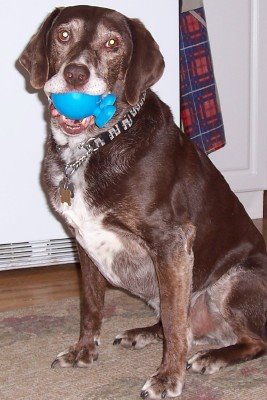
The other morning we saw three harbour seals wending their way toward Portage Inlet, and a lone fisherman on the bridge, which make us suspect that the herring may be running, which means spring is here! Doing his bird dog best, Anton has spent a challenging week here on the Gorge helping local water fowl to find their way back into the water where they belong. Luckily, as demonstrated, he can do this on one foot while holding a yellow rubber bone in his mouth. So talented. I am hoping to have him back, possibly on a dogshare basis, after I return from Austin. Over and out till Texas!

Labels: ,