Thursday, July 13, 2006

Fry on Form and Anchovy Amnesty

A book that has, I'm told, not received the best of reviews lies open by my chair these days, and I'm enjoying it so far. The Ode Less Travelled is Stephen Fry's guide to Unlocking the Poet Within. It's a manual of metre, rhyme and form by someone who writes privately himself:
"I do not write poetry for publication, I write it for the same reason that, according to Wilde, one should write a diary, to have something sensational to read on the train."
(If only we Canadians had trains to read on we might be better poets and diarists…?) He quotes Auden on the difficulties of writing free verse:
"The poet who writes 'free' verse is like Robinson Crusoe on his desert island: he must do all his cooking, laundry and darning for himself. In a few exceptional cases, this manly independence produces something original and impressive, but more often the result is squalor - dirty sheets on the unmade bed and empty bottles on the unswept floor."
Lynne Rossetto Kasper has certainly produced something original and impressive in The Splendid Table, her 1992 guide to the cuisine of Emilia-Romagna, the Heartland of Northern Italian Food. Interesting and unusual recipes, including this pasta sauce (which I have only slightly tweaked) which she says comes from the cooks of Modena's and Ferrara's Jewish communities. It features a substance unfairly despised and misunderstood in North America: the amazing anchovy. Be not afraid, and you will be fed.

Lemon Anchovy Sauce (Bagnabrusca):
2 2-oz cans anchovy filets
1 cup cold water
6 tbsp extra virgin olive oil
1 large clove garlic, minced
1/2 cup water
2 large fresh tomatoes, peeled, cored and chopped
6 tbsp minced flat-leaf parsley
3 tbsp fresh lemon juice
Freshly ground black pepper to taste.
  • Rinse the anchovies and soak them in the cup of cold water for 10 minutes. Drain and coarsely chop.
  • In a 12-inch heavy skillet, heat the oil over medium heat. Add the garlic and saute until faintly golden but not brown.
  • Add the parsley and anchovies and heat briefly, 30 seconds or so. Immediately stir in the 1/2 cup water and cook over low heat about 2 minutes, until the anchovies melt (isn't that the coolest thing??).
  • Blend in the tomatoes and lemon juice, raise the heat to medium, and cook 1 minute.
  • Generously season with black pepper and scrape the pan over hot drained pasta - tagliarini is recommended. Toss to coat. Sprinkle with a further tablespoon of chopped parsley and serve (without parmesan or other cheese).

Labels:

Tuesday, April 18, 2006

Chicken salad and the mysteries of poetic craft

In a weak moment I bought one of those pre-barbecued chickens, basted in salt and lathered with a toxic red substance. Still, it left me with enough cold chicken for a good old chicken salad, a food that - like tuna casserole - was mysteriously absent from my upbringing and which I have embraced in later life. Here's a perfectly straightforward recipe, based on one from the Fanny Farmer Cookbook:
2 cups cooked chicken, skinned and chopped
1 chopped green onion
1 rib celery, chopped
1/2 cup mayonnaise
2 tbsp plain yogurt
1 tbsp wine vinegar
Salt and ground pepper to taste
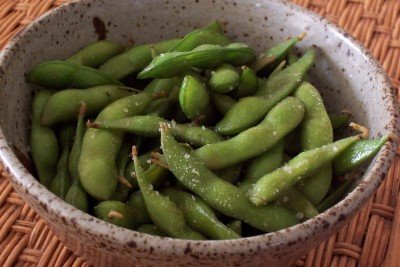
Combine mayonnaise, yogurt and vinegar and blend well; add seasonings. Toss chicken, onion and celery with dressing until well mixed. Serve as a salad, on a bed of greens, or as a sandwich filling, on toasted English muffins. Why mess with simplicity? Have it with a lovely bowl of Edamame, drizzled with sesame oil and dusted with salt.

It hardly needs saying that Mark Strand is not a chicken, or a salad, nor even simple, but interesting to know he is Canadian-born (PEI). I first came across his name as co-editor (with Eavan Boland) of the form poetry anthology, The Making of a Poem. He's also published a handy little book of essays on poetry called The Weather of Words. I'm finding it heavy going, but there are always moments in any such collection, and so I soldier on. I thought this, from the start of Notes on the Craft of Poetry, was an interesting take on it:
"Each poem demands that I treat it differently from the rest, come to terms with it, seek out its own best beginning and ending. And yet I would be kidding myself if I believed that nothing continuous existed in the transactions between myself and my poems. I suppose this is what we mean by craft: those transactions that become so continuous we not only associate ourselves with them but allow them to represent the means by which we make art… To a large extent these transactions I have chosen to call craft are the sole property of the individual poet and cannot be transferred to or adopted by others. One reason for this is that they are largely unknown at the time of writing and are discovered afterwards, if at all."
He quotes Orwell's rules of good writing, and questions whether these or any rules can really be applied to poetry: "For the poems that are of greatest value are those that inevitably, unselfconsciously break rules..."

His argument against craft is that it cannot work as a defining or diagnostic concept, because poetry "cannot be understood so much as absorbed." He seems to be an advocate for mystery, arguing that we not attempt to impose a structure on the process of creating poems, because to do that is to imply a common purpose for poetry, which it eludes, because a poem's purpose "...is not disclosure or storytelling or the telling of a daydream; nor is a poem a symptom. A poem is itself and is the act by which it is born. It is self-referential and is not necessarily preceded by any known order, except that of other poems."

Labels: , ,

Monday, April 17, 2006

Skating into form

I spent some time excavating my magazine basket, and came across a copy of The Writer's Chronicle from December 2004. I must have picked it up at the Vancouver AWP conference. There was an interview in it with Annie Finch, talking about her shift from free verse to form, a transition she says took her 20 years to make.
"I wanted to be challenged more deeply as a poet, by a more profound kind of anguage resistance, and in the end I found only form could offer me that. I got tired of feeling that the content was overpowering the words themselves; I wanted more 'opacity,' to use Charles Bertstein's term."
She began using form while doing her MFA in Creative Writing, in spite of rather than because of the guidance she found there:
"...people kept saying, 'this poem would be a lot better if you wrote it in free verse.' But I was set on training myself to use form well, so I just kept on with it."
She has several different strategies for choosing a form for a particular poem:
"When a line drifts into my head, I often recognize it as a certain meter or sense that it would be a good refrain line for a certain form, or a good chant line or part of a final couplet, that sense of where it might fit can be part of the sense it gives me. So, often the poem brings the structure with it… But sometimes it's the opposite, especially with a form I am not very familiar with yet: a poem will bug me for years, and it just won't be finished, until finally I hammer or coerce it, or let myself be coerced by it, into its right shape… And there's a third way too. I am not one of those poets who turn up their noses at the idea of using a particular structure on purpose; the shape of some of my favorite poems came first. For example, when I wrote A Carol for Carolyn for Carolyn Kizer… I wanted to write a carol for obvious reason, and I wanted it to be in amphibrachs before I even started, because that was the hardest meter I knew and I wanted to write her something special."
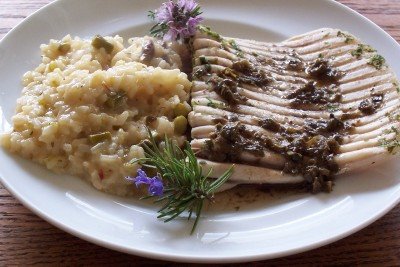
A pressing engagement to hunt Easter eggs yesterday, followed by a beautiful lamb dinner, meant I only had lunch to cope with, having been wallowing in blueberry muffins since breakfast. I was startled to find a fresh skate wing in my local grocery store, which got me thinking about the last time I'd had skate in black butter, which must have been about six years ago, at my only visit to Sheekey's: a memorable meal -- and not cheap. (We even got to do a little celebrity spotting, because Janet Street-Porter was dining there that night.) Skate is the perfect fish: delicate, easy to cook, and, for all intents, boneless. Even the recipe was easy to find. So to complicate life a little bit, and because my rosemary bushes are in full bloom and begging to be used, I also made a lemon risotto which I spiked with a handful of asparagus, just because it's spring.

Labels:

Wednesday, April 12, 2006

Villanelle

Blues-oriented form fiends may like to check out the latest Paul Reddick cd, Villanelle. I heard him interviewed a while back, but wasn't paying full attention at the time; it seems to me he said that many (all?) of the songs on the album incorporated formal elements from poetry, but I haven't been able to find that interview or any corroborating evidence.

And that somewhat predictably brings me to Dylan Thomas, whose Do Not Go Gentle Into That Good Night, for his dying father, remains the most stunning villanelle I've ever heard.

Two years ago today - it was the morning of Easter Monday - my own dad passed away. Here he is, sailing for London.

Labels:

Tuesday, April 11, 2006

Purdy, Pinsent, prosody and apostles

Al Purdy's very topical just now. Not only is his Rooms for Rent in the Outer Planets: Selected Poems, 1962-1996 up for Canada Reads , the CBC is airing a documentary about him called "Yours, Al" this coming Thursday, April 13, on CBC Television's Opening Night. The show stars Gordon Pinsent as Al Purdy and is on at 8 pm local time across Canada.

Meanwhile, I've wantonly picked up yet another book to browse. The house is pretty well carpeted with half-read books on prosody and form these days. Annie Finch, in her new collection of essays, The Body of Poetry: Essays on Women, Form and the Poetic Self , kicks off and out with a chapter on metric diversity, arguing against the championing of iambic pentameter as the premier English meter. "The use of the single label 'iambic' to include lines in other meters, she says, "…may prove to erase what it assumes to include, just as the generic use of the pronoun 'he' - said to include females - arguably erases female presence."

With Easter coming, English cooks are busy making Simnel Cake, pretty much just a fruit cake with marzipan topping, but something virtually unknown on this side of the Atlantic. Apparently its roots lie in another English holiday, Mothering Sunday, which takes place in March. Serving girls were permitted to visit their mothers on this day and the practice was to bring a simnel cake to prove how clever they were (if they made a good one, it would stay moist and tasty till Easter). Its presence at the Easter meal has to do with the 11 marzipan balls that decorate the top, representing all the Apostles except Judas. Perhaps with the new evidence that surfaced last week we can bring the numbers back to an even 12...

Labels:

Thursday, April 06, 2006

Next year in West Chester

I have been looking with longing at the program for the 12th Annual West Chester University Poetry Conference: Exploring Form and Narrative. Among the offerings are workshops on rhyme with Dick Davis, meter with Timothy Steele, a master class with Mark Jarman, and a keynote address by James Fenton, who is also interviewed by Dana Gioia. Alas I can't fit it in this year, but perhaps I can make the thirteenth edition next year. Never been to Pennsylvania...

Back here on the Coast, I was minding my own business on Tuesday afternoon… well, to be truthful I was engaged in some anguished last minute edits of my poems for the final Form in Poetry class, when the phone rang and Peg said: so, we've just got some fresh crab, want to come over and help us eat it? I dithered for a number of seconds, remembering several ill-starred occasions under the sign of the crab back in my Edmonton days. Then I thought, well, maybe it was a passing thing. Maybe it was bad frozen crab crossed with too many libations. Maybe it was just time to give it another try. So I brought along a quiche lorraine for a back-up, but the crab was fresh and simple, boiled in salt water, needing nothing but a nice bit of french bread and salad. And it went well with gin! The best news was that I suffered no ill-effects at all, so that strikes off the only food I've ever believed I was allergic, or at least intolerant to. I am grateful.

Labels:

Friday, March 24, 2006

Glosas & a few words about rejection

I've been working on a glosa arising from a quatrain by our late lamented high priestess of Canadian poetry, Gwendolyn MacEwen. An interesting thing, the glosa. Aside from Marilyn Hacker, who seems to have tried every form invented, you don't really see them much by any but Canadian poets. That PK Page has a lot to answer for! In her inspiring collection, Hologram, she defines it as a stanza form, based on a quatrain by another poet, consisting of four 10-line stanzas where the 6th and 9th lines rhyme with the 10th. (Pah, child's play, sez I after wrestling through 9 stanzas of terza rima..)

But my research tells me that it is also considered pretty much a nonce (love that word) form, also known as a glose (that seems to be how the Americans spell it) and that you can use any number or kind of lines as your starting point: they need not even be poetry. Neither is there any law that says the stanzas must be ten lines or follow any particular rhyme scheme.

The art of it is, I think, firstly to find a way to make the source lines your own, so that they have - fully - two lives; and secondly to walk a fine balance between bringing your poem to its own life and paying appropriate tribute to the source poet's words. Choosing those source lines is difficult enough, and it's good to know we can look beyond quatrains for them.

Rejection. Ouch: it never stops hurting, but I guess in this world so overcrowded with words we can't write without it. One of the AWP sessions in Austin that I wasn't able to make centred on The Resilient Writer, a collection of interviews with writers who survived to talk about rejection. Meanwhile, I found a blog about rejection by an editor who helpfully and comprehensively explains the nature and context of rejection letters... in a way that doesn't hurt... TOO much.

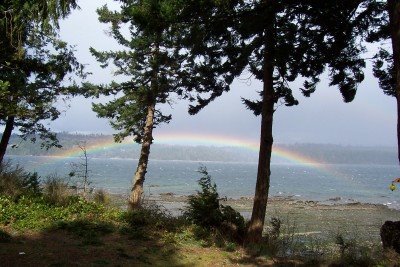
So up here in Fanny Bay we might not have escaped another day of rain, but we did get a bucket of oysters for supper last night, and this morning a real live rainbow!

Labels:

Wednesday, March 22, 2006

Chicken and rhetoric

What I was really craving last night - and had defrosted a small flock of chicken thighs in anticipation - was Chicken Jeera, but too late discovered that the nub of ginger in my fridge was mummified beyond reconstitution. Claudia Roden to the rescue! Her Mediterranean Cookery has been endlessly helpful to me in the past, and last night she gave me Pollo al Rosmarino, which instructs that a couple of sprigs of rosemary and a couple of halved cloves of garlic be heated in a mixture of butter and oil, to which you add and brown your chicken pieces (I had 6 thighs), and then throw in a glass of white wine, some salt and pepper, and turn it down to simmer for half an hour. Very nice it was, molto facile; eaten with potatoes, onion and zucchini cubed and cooked in lemon, butter and garlic, with a bit of fresh asparagus, it was just the thing to end the day.

Anyone who read Jill Tedford Jones' article about Elizabethan sonnets and country and westen lyrics may have been as intrigued as I by the sheer number of rhetorical devices named in the piece. We use them in our poetry all the time, without necessarily knowing what they're called. Tedford Jones speculates that "the student in Queen Elizabeth's day could probably easily identify and create more than a hundred such devices," while I could define perhaps half a dozen. So I'm going to work through these ones, consciously injecting one or two (devices, not terms) into new poems, and who knows, if you're really unlucky, perhaps make my conversation more polysyllabic from now on. I found a couple of helpful sites - American Rhetoric and The Forest of Rhetoric - to help me get started. Here's my Greek chorus:
anaphora
anastrophe
anadiplosis
antanaclasis
antimetabole
antithesis
apostrophe
appositive
chiasmus
ellipsis
epanalepsis
epistrophe
hyperbaton
hyperbole
metonymy
onomatopoeia
parenthesis
paronomasia
polyptoton
polysyndeton
syllepsis
symploce
synecdoche

Labels: ,

Monday, March 20, 2006

Leonard on form

At the beginning of February, CBC presenter Shelagh Rogers - the best voice in the west? - interviewed our national icon Leonard Cohen about his induction into the Canadian Songwriters Hall of Fame. She talked to him about poetry as well, and he had some interesting things to say about the benefits he'd had from working within the "obligation of rhyme". "Lift your heart in gratitude," he says, because it lets you discover congruencies you'd never otherwise encounter. He likes form too:
“Form imposes a certain opportunity to get deeper than your first thought... I don’t have any ideas and I don’t trust my opinions… but when you submit yourself to a form then… you’re invited to dig deeper into the language and to discard the slogans by which you live, the easy alibis of language and of opinion… If you look in the Spenserian stanza for instance, which is a very, very intricate verse form where you have to come up with many rhymes of the same sound, you’re invited to explore realms you usually don’t get to with your ordinary easy thought… I consider my thought stream extremely uninteresting and it’s only when I can discard it that I can say something that I can get behind.”
While you're hanging around the CBC site, try searching 'Leonard Cohen': I stumbled upon a CBC Archives clip of him reciting poems back in 1958...

Labels:

Thursday, March 16, 2006

Music 'n poetry

Just received my brochure for the Wired Writing Studio which starts with the Banff Centre residency October 2-14, 2006. A wonderful thing is Wired. Robert Hilles and Marilyn Dumont will be excellent poetry resources. Fred Stenson runs a comradely ship, with the hilariously droll technical support stylings of Chris Fisher. The food's not bad either, and there are some great deals on concerts for participants: I began my lifetime of fandom to the Jaybirds early in my stay, and also attended a bone-shaking appearance by Steve Earle and the Dukes (I prefer him acoustic, thanks, but good to have had the experience). And the Calgary/Banff Wordfest happens during the studio time as well. Geez, what am I waiting for??

Among the many musical offerings we noticed in Austin, the best ones all seemed scheduled to begin after we left. The rodeo, the SXSW conference, everyone but AWP seems to schedule music. (Actually that's not fair: there was a boogie night at AWP that we were simply too whacked to attend.) Playing in town after we left: Eliza Gilkyson, Ruthie Foster, The Gourds, Bela Fleck & the Flecktones, Lucinda Williams, Rhonda Vincent. It's not fair it's not it's not. But I have to think, on the other hand, why do I know about these people? Because I have seen them play way up here, at the Vancouver Island Music Festival in Courtenay/Comox, and the Edmonton Folk Music Festival. All that is except Bela and he comes up here from time to time, so I live in hope. And except Lucinda, because you have to have some event to look forward to.

So I spent yesterday meditating on oulipo. It sounds like about as much fun as you can have with poetry, but I need more than that, or do I mean less, to move me in a poem, and I wonder at the wisdom of narrowing the readership of the already microscopic readership of poetry for the sake of intellectual gymnastics. Old fartism I suppose, and there are doubtless many fine, coherent examples out there I wouldn't guess were oulipean. Christian Bok certainly made headlines with Eunoia a couple of years ago, each section consisting of poems made of words that use only one vowel. Damned clever it may be, but it's not for me, except in small doses. There's no getting around the fact you have to compromise the sense of a line when you're performing that scale of legerdemain. Anyway, I found a charming interview by John Ashbery with Harry Mathews, the only American oulipoean, which was worth the journey.

So the point of all this was that we had to invent our own form and write a poem in it for last night's class. I decided, since I was in sonnet mode, to mess with that. I took the end-rhymed words from an existing sonnet (arbitrarily chosen; I used Richard Wilbur's Praise in Summer) and used them as the first word of each line of a new poem. To escalate the challenge, I decided to invert the metre into predominantly trochaic pentameter (which makes sense since the chosen words were stressed syllables from the end of iambic pentameter lines) and to rhyme as best I could the first word of the line with the last, so that the poem still rhymes (murderous rhyme scheme too: ababbcbccdcdaa), but it does so at both ends of the line, which pleased my symmetrical soul. Some of the rhymes had to be feminine rather than masculine, and a lot of them are very loose, but I did what I could. And I thought I should mirror, to some extent, the meaning of the source poem, so mine is a rant about winter. It took me so long to write it ended up being an imperfect first draft and I'm waiting for workshop feedback next week before I carry on working it, but I enjoyed the challenge.

Labels:

Wednesday, March 15, 2006

Sonnets a-gogo

Double-barrelled week for me, this. I missed last week's class on sonnets and am plunging in to the one on oulipo. Thought I'd catch up on last week by reading the always readable Don Paterson's introduction to his anthology, 101 Sonnets. He did not disappoint:
"Academics, in particular, have talked an awful lot of rubbish on the subject of rhyme; they often make the crucial error of failing to understand that the poem ends up on the page as a result of a messy and unique process, not a single operation."

"Rhyme always unifies sense, and can make sense out of nonsense; it can trick a logic from the shadows where one would not have otherwise existed."

"…[the sonnet is] a box for [poets'] dreams, and represents one of the most characteristic shapes human thought can take. Poets write sonnets because it makes poems easier to write. Readers read them because it makes their lives easier to bear."

And the anthology is a little treasure, not least because of Paterson's brief notes on each piece tucked away at the back of the book. So helpful to have had someone else do the brow-clutching and rhyme analysis for us.

I also enjoyed reading the American queen of formalism, Marilyn Hacker, who wrote the chapter on sonnets in An Exaltation of Forms. She notes that the North American rant against form often uses the sonnet as its kicking post, and that this scale of objection is absent from British and Irish debate "perhaps because the sonnet, if an 'interloper' from the Romance languages, nonetheless has five hundred years of history in their literature..." And nonetheless herself finds early and perhaps unexpected examples in American literature: Ezra Pound, H.D. and Gwendolyn Brooks.

What both poets say is that sonnets have had a bad rap, to be tagged as difficult and constricting. But poets, it seems - if the Oulipians are anything to go by - not only thrive on difficulty but invent it if it appears to be lacking in their lives:

Raymond Queneau, Oulipo’s co-founder: Oulipians are "Rats who build the labyrinth from which they will try to escape."
As for eats, this week has been a wash since return from foodsville, TX. Not least because there's been no time to get to the grocery store and I've been surviving on things I stashed in the freezer before I left, and a few limp vegetables that survived my absence. I did attempt cajun blackened ribs last night, but although they were acceptably spicy, I'd call them undistinguished. I think I prefer tomato-based rib recipes. The spice mix will be employed in further experimentation once the weather warms enough to bring out the barbecue.

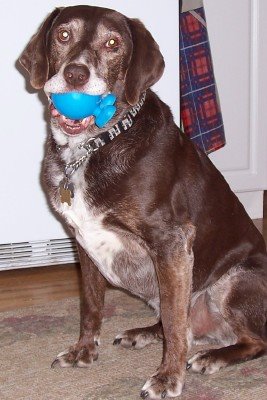
Anyway, Anton the awesome is returning for indefinite stay tomorrow. Maybe I'll make him some Flea Fighting Biscuits to welcome him home? These rely heavily on garlic and brewer's yeast to work their magic. Gives dog breath a whole new dimension...

Labels: ,

Thursday, March 02, 2006

Meter mania

The lovely Saskatchewan-born neo-formalist Elizabeth Bachinsky shared her passion for sonnets with Kate Braid's form class in Nanaimo last night. She is very fond of palindromes and Sapphic stanzas as well, and her first book, Curio, included a translation into anagrams of part of The Wasteland. She has done some wild things with Google search results too.

There was a preliminary discussion of meter, and while reading the chapter on Iambic meter from the excellent text, An Exaltation of Forms, we ran into diverging opinions on how to scan the line, which I now learn is "oft-debated" in scansion: "When to the sessions of sweet silent thought" (--Shakespeare, Sonnet 30).

Kate said that Keith Maillard had once told her that it was important not to confuse rhythm with meter and that this had made sense of the metrical world for her. If I'm paraphrasing her correctly, she said that rhythm has more to do with the emphasis we might put on a line when we read it, and meter is the more abstract "unreal" template we put over that line to measure it, within the context of the rest of the poem.

I'm still puzzling on that, but I found something that supports Maillard's view, if music and poetry are this strongly connected, on a page about music theory. It says:

Many modern conceptions of rhythm and meter place them in opposition. Rhythm is often defined to consist of the actually sounding durations of music, while meter is the alternation of strong and weak beats, or the interaction of pulse strata, that are inferred from the rhythm. Rhythm is thus conceived as emerging and active— a "concrete" patterning that is measured by, and heard to work with or against the "abstract," deterministic, rigid metrical grid.

Does that make sense to anyone? A couple of us thought the line (see second paragraph above) could be scanned as more or less straight dactylic tetrameter (quibbles over whether "silent" could be read without an initial stress, in context), but others wanted to put it into iambic pentameter with a double ionic (unstressed/unstressed/stressed/stressed) foot in the middle and a trochaic substitution in the first foot.

Ok, any [other] prosody geeks out there? For the rest of us, I like this page for a nice basic summary of meter. And I was having a little fun today with this one that has some online quizzes and tutorials on prosody.

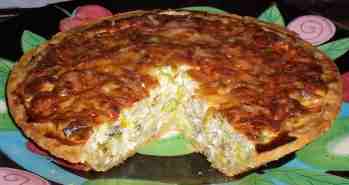
And for those of you who prefer food, here's what I had for supper last night (Rich Leek Tart, it's called). Obviously I have a long way to go as both a cook and a food photographer, but it was pretty tasty. The leeks were sweated for about half an hour, with minced shallots and a couple of sliced mushrooms, before being mixed with strained yogurt, swiss cheese and eggs, and the result was sweet and dense; it almost tasted like I'd added sugar.

Labels: ,

Thursday, February 23, 2006

Closing Time

Almost done the 2006 winter colony, and counting down to this evening's final readings and (thank you artists) studio visits. We have scaled the chip mountain and made our contributions to the local economy. We have written and read and walked and skied and skated and scrabbled. We have exchanged the obscurest trivia and the easiest recipes; blogged and emailed and even pinned writings to our doors. And tomorrow we return to reality.

Wednesday's afternoon highlight was a visit to St Peter's Cathedral, with live commentary from Fr. Demetrius. I'd heard about the paintings by Berthold Imhoff from people who'd been there before, and they were something to see in the streaming sunlight.

Spent the past three days wrestling with terza rima. Fiendish, I call it. Paul Farley calls it "the very devil of a form" in his review of George Szirtes' book, Reel. But it was an invigorating work-out, and although I'm still grappling with a final sticky rhyme (--any suggestions for rhyming "novel" with other than "grovel"??) I might be fool enough to attempt it again sometime. Some other imaginary time when I have the luxury of three days to spend on nothing but sifting three way rhymes for iambic lines. **11:21 Update - since I can't figure out how to include hyperlinking in comments - Thanks Ariel: hovel it is. I love Rhymezone too but I must say that after this exercise I have developed a renewed passion for my poet-centric Poet's Manual and Rhyming Dictionary, which gives masculine, feminine and triple rhymes, and makes it fairly easy to work out half rhymes.

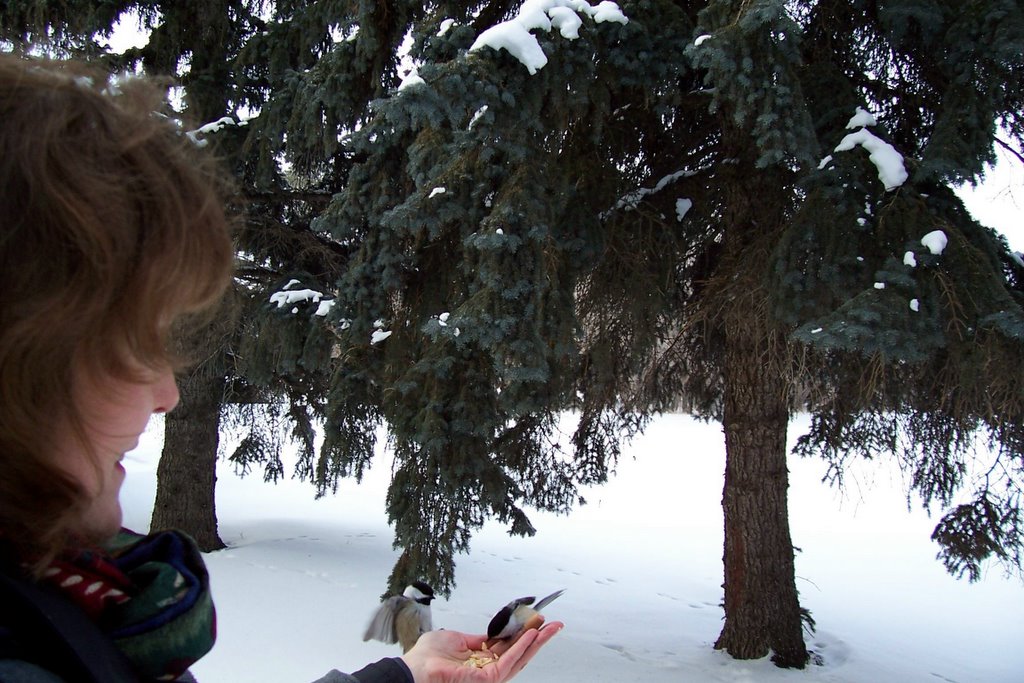
Hoping I experience again the miracle of St Peter’s and weigh in at home to discover I haven’t gained (or lost) an ounce despite two weeks of feverish chip consumption, daily cocktails, lashings of gravy on everything, and a respectful sampling of each and every dessert on offer. And only two hours of badminton in the balance. But I like to believe that all those hours spent out on the lane to the cemetery, ungloved, with a palmful of peanuts, feeding chickadees and braving incipient frostbite, have some counter-calorific effect.

And so, as that classic British football ballad has it,
Here we go, here we go, here we go, here we go, here we go, here we go-o…
(rep. refr.)

Labels: ,