Wednesday, November 10, 2010

Poetry v. poultry


Aldeburgh ended with a lecture and a reading. At the crack of noon-thirty, our English comprehension was sorely tested by Don Paterson's speed-readings of a selected few of Robert Frost's poems (West-Running Brook; Design; and To Earthward). He peppered his talk with a few high-falutin' bits of terminology (autopoiesis, domain theory, thematic domain, emergence) which seemed to be summable as: Frost's poems are highly crafted and admirably self-contained with imagery so integrated the poems are unimaginable in any other form. Well, quite: but much better said in a talk which we can only hope will soon appear on Paterson's website where we can enjoy it at a slower speed.

We sprinted out for some fish and chips


and were back in our seats - after a quick and admiring visit to Lawson's Deli


and a sudden drenching by the changeable weather - in time for the final reading. We heard from Lars Gustafsson (Sweden), Marie Howe (USA) and Bill Manhire (New Zealand).

A couple of days' rest and fasting in London ensued. Yesterday I roused myself and joined a small throng of sustainable foodies


to travel to a different part of Suffolk for an Ethical Eats farm visit to Longwood Farm, run by Matthew and Louise Unwin. We were accompanied by Alison Mood from Compassion in World Farming, who gave a short presentation - somewhat hampered by technological glitches during the showing of this video on the treatment of farm animals.


After the talk, we were fed an enormous lunch featuring chicken and vegetables raised on Longwood Farm. We hoisted ourselves to our feet and with organic farmer and butcher Matthew Unwin


as guide, set off on a tour of the farm, which includes beef,


turkeys, chickens, sheep and geese (and an excellent farm shop stuffed with organic vegetables and grocery staples).


An organic pig farmer leases land on Longwood Farm as well, operating on a four-year rotation. This encourages soil fertility and the growth of forage crops for the other animals. The pigs are moved onto new ground as they're weaned, so the process takes about six months each year.

A warm interlude in the chick barn, where week-old fluffballs were basking under a heat lamp and listening (no lie!) to The Archers. Where chicks are reared like these ones, without the medications routinely administered in conventional animal farming, organic farmers expect to lose a small percentage, particularly in the first week or so (he'd lost 14 of the 400 we saw). They are kept indoors and warm until they are about 3-4 weeks old, and given some heat until they are about 6 weeks old, after which they can spend the rest of their lives freely ranging (to meet regulations, two-thirds of their life must be lived free range). They live in sheds on runners, so they can be moved around the property, and at their earliest age can fall victim to a surprising list of predators: seagulls are the worst offenders, but rats and crows can also go after them.


We had a sobering lesson in fowl behaviour and the gruesomely literal imposition of the pecking order when we reached the farthest chicken barn. Most free range chickens like this are happy and peaceful enough, but every few years, says Unwin, there's a savage lot - probably only one or two troublemakers who manage to rile the whole flock. They start fights that end up with one of their number killed, and then eaten (like pigs, chickens are not vegetarians - which we witness less queasily in their fondness for insects). He has been trying to identify the perpetrator but so far hasn't found it, and in the meantime regularly finds corpses. These chickens are being reared for the Christmas market so will be slaughtered at 16 weeks when they are good and plump, so the problem won't go on much longer for this group.

The turkeys were numerous and curious. Organic pasture-raised Kelly Bronze turkeys like these command about £12.50 a kilo. They take 6 months to rear and are then hung for 3 weeks. Their flavour, of course, is excellent as a result, and they are free of the medications that intensively farmed turkeys are administered from day one.


Unwin has a lot to say about the differences between organic and intensive farming. When discussing the price of his turkeys, he drew what I thought was a very apt comparison: while people are willing to pay a premium for quality in cars, acknowledging for example that there are good reasons why a Rolls-Royce or Ferrari should cost so much more than an everyday beater: but when food-shopping by price alone as we've been taught to do, consumers don't recognise the comparable difference worth paying for in food. Which is endlessly ironic in this one consumable that we so literally consume.

(In comparison: intensively-farmed Broad-Breasted White turkeys - bred, as we all surely know now, to be so top-heavy they're unable to breed naturally - are typically brought to slaughter weight at 4 months. Having legs too weak to support their weight, and being reared in overcrowded conditions, they do not develop a normal muscle structure, so the flesh of the Broad-Breasted White is soft and watery (partly due to processing which means they are soaked in a water bath, and may absorb up to 5% water as a result) and heavily oriented to white meat.)

Labels:

Sunday, February 15, 2009

Counting chickens

Last night's chicken dinner (roast chicken with the skin removed and no gravy?!) brought to mind all kinds of chickeny issues. Like the Victoria Film Fest's screening of Mad City Chickens which was most entertaining and made me wish for a little coop in my own backyard. I loved the tale of Consuela the battery hen who was rescued from a Wisconsin dump - she was one of the old laying hens who'd been gassed and dumped by the local battery egg operation, only "they don't always die" according to the guard at the gate. She'd been debeaked and was nearly bald from the crowded conditions she'd been living in, but with a little TLC and daily handfuls of greens from her foster mother she revived and started laying again.

Which brought to mind the opening chapter of Singer and Mason's book, The Way We Eat, and its discussion about the different breeding aims for different kinds of poultry. Battery hens are bred to live long enough to produce eggs at top capacity, while broilers are raised to be hungry - so they gain weight rapidly enough to be slaughtered at 6 weeks. Which basically means surplus battery hens are not the right shape for today's chicken dinners, which is how they end up in landfills.

Although chickens have a lifespan of 5 years, those manipulated into high-yield egg laying last a little more than a year; there is an industry practice of forced moulting which causes them to lay a bit longer; this involves starving them for between 5-14 days, and depriving them of water for part of this time. When they are finished as layers, they are killed, not always humanely. Let us just say that the Coen Brothers were not the only ones to find a novel and revolting use for a chipper.

And there are other living by-products to dispose of. Battery hens lay eggs, some of which are intended for hatcheries to produce more battery hens. But male chicks are an unwanted by-product, much like the male calves from dairy cows. In the example cited by Singer and Mason, male chicks are dropped (sometimes live) into the garbage; a UK website on factory farming says male chicks are killed and their bodies used for animal feed or fertilizer.

Some clarification over egg types, by the way. Unless otherwise labelled, the cheap white eggs in every supermarket are from battery hens, living in unspeakable conditions in cages too crowded to allow them to stretch their wings. Free run eggs are from hens that are not caged, but may be living in overcrowded conditions in barns; free range eggs are from barn-reared chickens with access to the outdoors (which they may elect not to use); organic eggs are from hens fed on organic feed; and if the words 'pasture-reared' appear anywhere it means the hens were raised outdoors.

Chicken issues are very topical, at least in the UK. Last year celebrity chef and sustainable food advocate Hugh Fearnley-Whittingstall and others embarked on a public information campaign about factory farming of chicken. And Felicity Lawrence's Not on the Label spilled the beans on EC regulations which allow the injection of chicken with hydrolized animal proteins so that they will better retain the water this meat is injected with, boosting its weight and retail value while giving it that characteristic industrial texture of soggy cardboard.

After reading a bit more about de-beaking, which, depending on the method used, can be the equivalent of having your nose sliced off by a hot razor, and is done to prevent aggression and cannibalism (caused in turn by overcrowded conditions) among battery hens, I browsed the website of United Poultry Concerns, which aims to raise awareness about battery hens and industrial poultry rearing. And because I do love a chicken dinner, as long as I know where my chicken came from, I thought with some gratitude about having Farmer Dan within reach, to sell me pasture-raised organic chook.

In brighter news, I'd heard that Oak Bay, notorious for restrictive bylaws, had relaxed its rules on keeping backyard chickens. Not sure if this is the change I'd heard about, but the poultry section of the animal control bylaw there was amended last August to allow up to 5 birds to be kept, as long as your lot is large enough.

And if you've read this far, you deserve to read Steven Dobyns' excellent poem, Spiritual Chickens. Brraaaawk!

Labels: ,

Tuesday, July 18, 2006

Boris, Billy, Ted and a nice roast chicken

A little awkward to post while being harassed by my desk ornament (yes, folks, Boris is back... he had the sneezes and needed another round of antibiotics so, well, umm...)

Been reading a new Billy Collins (The Trouble With Poetry and Other Poems, Picador 2006) and liked this bit, from Monday:
The proofreaders are playing the ping-pong
game of proofreading,
glancing back and forth from page to page,
the chefs are dicing celery and potatoes,
and the poets are at their windows
because it is their job for which
they are paid nothing every Friday afternoon.

And a little more from Ted Hughes:
Much has been said about the therapeutic value of uninhibited writing, and though no doubt that can go to the point where mere confusion enters, it is one way of talking about the pleasures and the healing effects of reading and writing poetry.

All imaginative writing is to some extent the voice of what is neglected or forbidden, hence its connection with the past in a nostalgic vein and the future in a revolutionary vein.

I had a revolutionary experience with a roast chicken on the weekend. Following the guidance of Lynne Rossetto Kasper, I rubbed a whole chicken with olive oil and then slathered on a paste of 1 tbsp minced rosemary, 1 large minced garlic and 1/4 tsp salt, stuffed a couple of sprigs of whole rosemary in the cavity, covered it in plastic and refrigerated it for 24 hours, and then roasted it at 350f at 20-25 mins/pound, the first half on its breast and the second half breast side up, basting it with cooking juices at intervals until the thickest part of the thigh read 170f on the thermometer. It was gorgeous. The finish was to drizzle it with a 3-4 tbsp artisan balsamic vinegar (or slice it first and and drizzle with balsamic). It was beautifully moist and well flavoured.

While I told Jennifer about this triumph, she reminded me that only a few weeks ago I had been reading to her about the use of salt on meats. A magazine I'm extremely fond of is Cooks Illustrated, which is a food nerd's dream, featuring experiments from America's Test Kitchen (something I'd never heard of before I started reading the magazine). In the August issue they were performing merciless experiments on barbecued chicken and explained (with diagrams) the effects of salting chicken for 3 or 6 hours. At 3 hours the flesh does not absorb the salt and you end up with dry chicken (which is why popular wisdom says not to salt roasting meats). But after 6 hours, the salt is drawn into the flesh and you end up with flavour from the salt and from any other water-soluble flavouring agents (e.g. herbs and spices but not oil-solubles like capsaicin, the hot element of chili peppers). They prefer salting to brining if you are dealing with chicken because they found brining made the skin soggy, and salting leaves it crispier.

Labels:

Monday, May 15, 2006

More from the half read library, and turmeric

I was reading Adrienne Rich's collection of essays, What Is Found There: Notebooks on Poetry and Politics. I thought she gave a very cogent summary of issues around form:
"Poetic forms - meters, rhyming patterns, the shaping of poems into symmetrical blocks of lines called couplets or stanzas - have existed since poetry was an oral activity. Such forms can easily become format, of course, where the dynamics of experience and desire are forced to fit a pattern to which they have no organic relationship. People are often taught in school to confuse closed poetic forms (or formulas) with poetry itself, the lifeblood of the poem. Or, that a poem consists merely in a series of sentences broken (formatted) into short lines called "free verse." But a closed form like the sestina, the sonnet, the villanelle remains inert formula or format unless the "triggering subject," as Richard Hugo called it, acts on the imagination to make the form evolve, become responsive, or works almost in resistance to the form. It's a struggle not to let the form take over, lapse into format, assimilate the poetry; and that very struggle can produce a movement, a music, of its own."
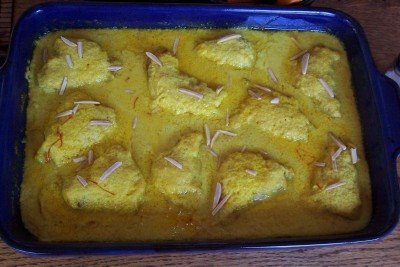
Last night's dinner was Saffron Chicken. Very smooth, complex sauce, bright yellow from the turmeric, thickened, and slightly crunchy, with ground almonds. An excellent recipe which can be made well ahead of events and heated up when needed.

Turmeric may be the new snake oil. In recent years it has gained new currency as an anti-arthritis wonder food under the name of its active ingredient, curcumin. Long used as a food colourant and fabric dye (though it fades), it has been reported to be an anti-inflammatory and an anti-cancer agent; a cure for jaundice, indigestion, kidney stones, dysentery, sexually-transmitted diseases, cystic fibrosis, diabetes, stomach and liver ailments including Crohn's and inflammatory bowel disease; even a preventative for Alzheimer's disease and cardiovascular problems, and a treatment for poor vision. Externally it is used to heal sores and inflammations, including itching, Herpes, psoriasis, chickenpox and smallpox; as a depilatory, a cosmetic and to counteract aging processes. And as we saw in the movie Water, you can rub it on hotheads to cool them down!

Labels:

Tuesday, April 18, 2006

Chicken salad and the mysteries of poetic craft

In a weak moment I bought one of those pre-barbecued chickens, basted in salt and lathered with a toxic red substance. Still, it left me with enough cold chicken for a good old chicken salad, a food that - like tuna casserole - was mysteriously absent from my upbringing and which I have embraced in later life. Here's a perfectly straightforward recipe, based on one from the Fanny Farmer Cookbook:
2 cups cooked chicken, skinned and chopped
1 chopped green onion
1 rib celery, chopped
1/2 cup mayonnaise
2 tbsp plain yogurt
1 tbsp wine vinegar
Salt and ground pepper to taste
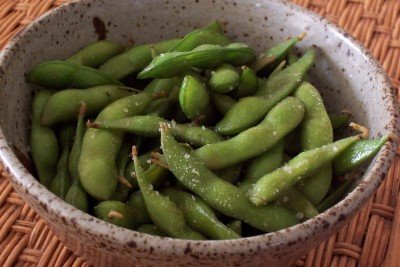
Combine mayonnaise, yogurt and vinegar and blend well; add seasonings. Toss chicken, onion and celery with dressing until well mixed. Serve as a salad, on a bed of greens, or as a sandwich filling, on toasted English muffins. Why mess with simplicity? Have it with a lovely bowl of Edamame, drizzled with sesame oil and dusted with salt.

It hardly needs saying that Mark Strand is not a chicken, or a salad, nor even simple, but interesting to know he is Canadian-born (PEI). I first came across his name as co-editor (with Eavan Boland) of the form poetry anthology, The Making of a Poem. He's also published a handy little book of essays on poetry called The Weather of Words. I'm finding it heavy going, but there are always moments in any such collection, and so I soldier on. I thought this, from the start of Notes on the Craft of Poetry, was an interesting take on it:
"Each poem demands that I treat it differently from the rest, come to terms with it, seek out its own best beginning and ending. And yet I would be kidding myself if I believed that nothing continuous existed in the transactions between myself and my poems. I suppose this is what we mean by craft: those transactions that become so continuous we not only associate ourselves with them but allow them to represent the means by which we make art… To a large extent these transactions I have chosen to call craft are the sole property of the individual poet and cannot be transferred to or adopted by others. One reason for this is that they are largely unknown at the time of writing and are discovered afterwards, if at all."
He quotes Orwell's rules of good writing, and questions whether these or any rules can really be applied to poetry: "For the poems that are of greatest value are those that inevitably, unselfconsciously break rules..."

His argument against craft is that it cannot work as a defining or diagnostic concept, because poetry "cannot be understood so much as absorbed." He seems to be an advocate for mystery, arguing that we not attempt to impose a structure on the process of creating poems, because to do that is to imply a common purpose for poetry, which it eludes, because a poem's purpose "...is not disclosure or storytelling or the telling of a daydream; nor is a poem a symptom. A poem is itself and is the act by which it is born. It is self-referential and is not necessarily preceded by any known order, except that of other poems."

Labels: , ,

Wednesday, March 22, 2006

Chicken and rhetoric

What I was really craving last night - and had defrosted a small flock of chicken thighs in anticipation - was Chicken Jeera, but too late discovered that the nub of ginger in my fridge was mummified beyond reconstitution. Claudia Roden to the rescue! Her Mediterranean Cookery has been endlessly helpful to me in the past, and last night she gave me Pollo al Rosmarino, which instructs that a couple of sprigs of rosemary and a couple of halved cloves of garlic be heated in a mixture of butter and oil, to which you add and brown your chicken pieces (I had 6 thighs), and then throw in a glass of white wine, some salt and pepper, and turn it down to simmer for half an hour. Very nice it was, molto facile; eaten with potatoes, onion and zucchini cubed and cooked in lemon, butter and garlic, with a bit of fresh asparagus, it was just the thing to end the day.

Anyone who read Jill Tedford Jones' article about Elizabethan sonnets and country and westen lyrics may have been as intrigued as I by the sheer number of rhetorical devices named in the piece. We use them in our poetry all the time, without necessarily knowing what they're called. Tedford Jones speculates that "the student in Queen Elizabeth's day could probably easily identify and create more than a hundred such devices," while I could define perhaps half a dozen. So I'm going to work through these ones, consciously injecting one or two (devices, not terms) into new poems, and who knows, if you're really unlucky, perhaps make my conversation more polysyllabic from now on. I found a couple of helpful sites - American Rhetoric and The Forest of Rhetoric - to help me get started. Here's my Greek chorus:
anaphora
anastrophe
anadiplosis
antanaclasis
antimetabole
antithesis
apostrophe
appositive
chiasmus
ellipsis
epanalepsis
epistrophe
hyperbaton
hyperbole
metonymy
onomatopoeia
parenthesis
paronomasia
polyptoton
polysyndeton
syllepsis
symploce
synecdoche

Labels: ,